
The Island That Looked Like Home: 2026 Jeju Island Sister-State Study Tour

Fourteen public school students from Hawaiʻi traveled to Jeju as ambassadors. They came back carrying something they hadn't expected to find.
The room had gone quiet.
Jhera Mae Paulo, a junior from Waiʻanae High School, had prepared a question for the Vice Governor of Jeju Special Self-Governing Province. She'd worked on it. But when the translator finished the previous answer, and the room fell silent, the nerves caught her. Her chaperone leaned over and said: go ahead.
She did. The Vice Governor listened, paused, and then, through her translator, called Jhera Mae's question "very advanced."
"It made me feel proud of myself for speaking up," Jhera Mae wrote that evening.
At that moment, a public school student from the Waiʻanae Coast, sitting across a conference table from a regional government official on the other side of the Pacific, her question landing, captures something essential about what PAAC's Sister-State Study Tour is designed to make possible. Not the polished version of global education. The real one.
A Program Built on Access
The 2026 Sister-State Study Tours didn't begin in March. They began, in many ways, at a two-day orientation at Chaminade University in February, where forty-two public high school students from across the state — flying in from Lānaʻi, Hilo, Kona, Maui, and Kauaʻi — came together before spring travel to three of Hawaiʻi's Sister-State destinations: Ilocos Norte and Ilocos Sur in the Philippines, Jeju Island in South Korea, and Okinawa in Japan.
The 2026 cohort represented a significant expansion. The 2025 pilot had sent 14 students abroad. This year, the program grew to 42 student ambassadors representing 42 public high schools statewide. Through a partnership between PAAC and the East-West Center, every student paid no more than $500 for the full experience — international airfare, lodging, meals, transportation, travel insurance, and immersive learning activities. That cap changed everything about who could say yes.
Before the Jeju cohort ever saw a packing list, they visited the United Korean Association of Hawaiʻi's Immigration History Hall, where they stood before artifacts tracing a century of Korean plantation life: the bango tag system, the picture bride era, the long arc of a community that built itself in the red dirt of these islands. Their orientation community panel featured William O'Grady, Jinyoung Lee, and Joyce Yang, who helped students understand that the relationship between Hawaiʻi and Jeju is not a diplomatic abstraction. It runs through families. It runs through memory.
Students left orientation already changed. They left for South Korea ready.
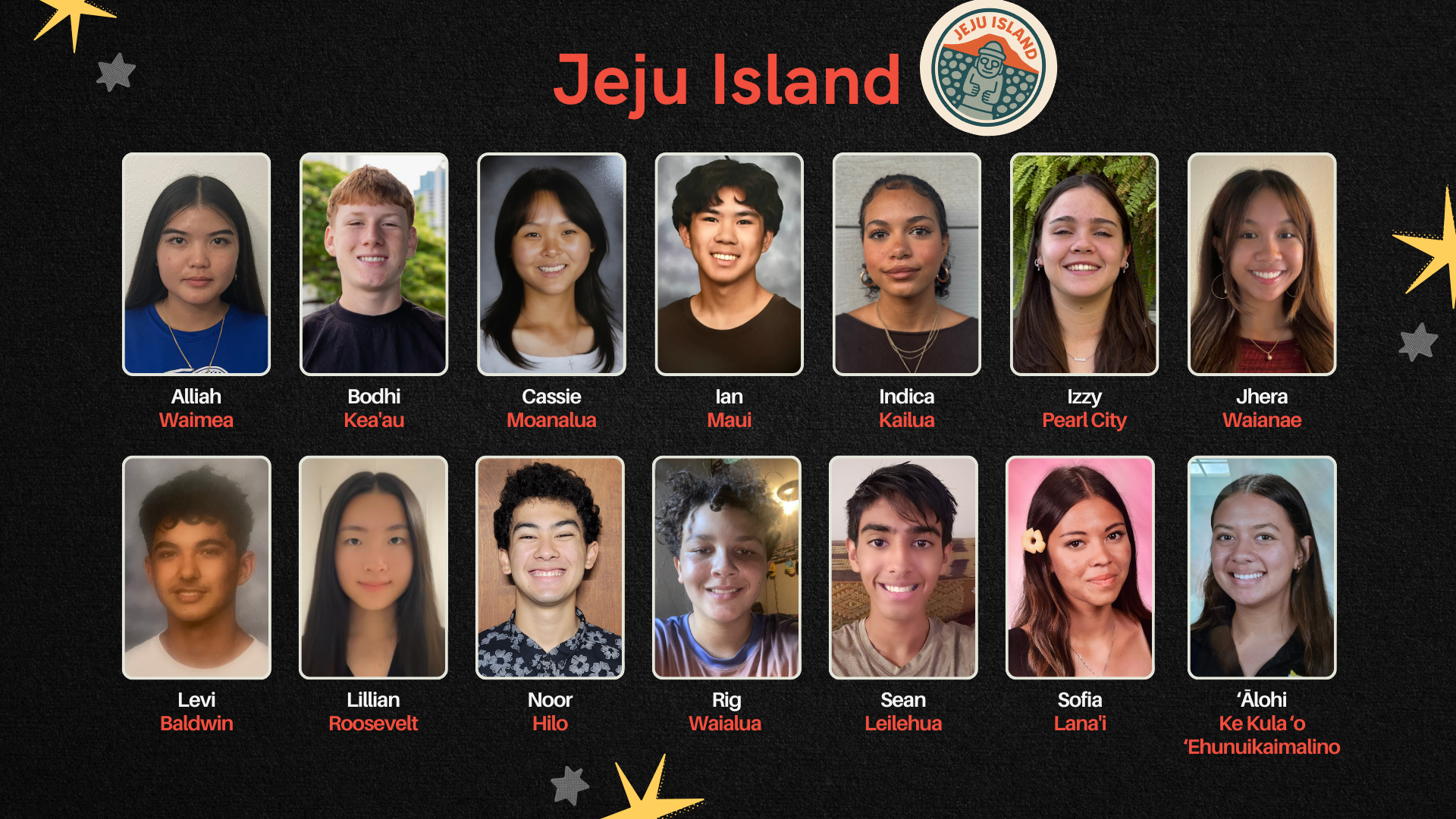
Fourteen Students. One Delegation.
In March, fourteen students from fourteen public schools — representing islands from Maui to Lānaʻi to the Big Island's east side — departed as Hawaiʻi's 2026 Jeju ambassadors.
They were Alliah Punzalan, Waimea High School. Bodhi Parker of Keaʻau High School. Cassie Nakaoka of Moanalua High School. Ian Payba of Maui High School. Indica Brown of Kailua High School. Isabelle Myers of Pearl City High School. Jhera Mae Paulo of Waiʻanae High School. Levi Short of Baldwin High School. Lillian Yim of Roosevelt High School. Noor Shehata of Hilo High School. Rig Lindley-Molina of Waialua High & Intermediate. Sean Palamos of Leilehua High School. Sofia Pimentel of Lānaʻi High & Elementary School. ʻĀlohi Medina-Oliveira of Ke Kula ʻo ʻEhunuikaimalino.
Each brought something different. ʻĀlohi was a Hawaiian language immersion student whose thinking about cultural survival would deepen every day. Sofia had grown up on Lānaʻi — small enough that you know the whole school — and arrived with a perspective shaped by island intimacy. Indica had never left the country. Levi, the youngest in the group, carried himself with steadiness beyond his age. Together, they were as varied as the islands they came from.
Wind, Stones, and Women
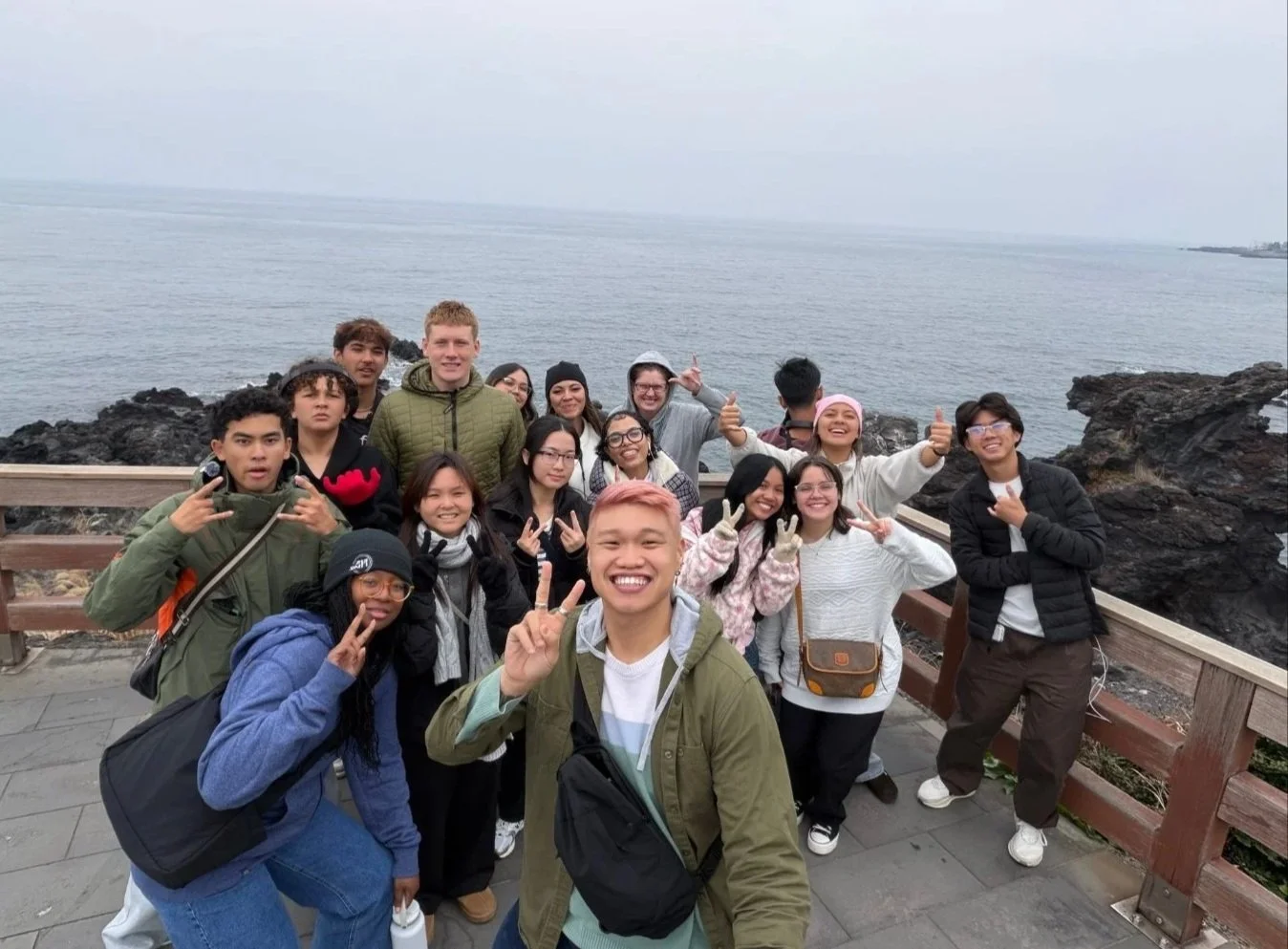
Group photo at Dragon Head Rock, First Day on Jeju Island
The cohort landed in Jeju to sea air and basalt. Their first stop — Dragon Head Rock along the island's northwestern coast — set the tone immediately. The black lava formations jutting into the gray-green water looked, to several students, startlingly like home.
"The rock formations reminded me of home," Jhera Mae wrote in her field notes, "and when me and my family would visit places like the Blowhole on Oʻahu." Bodhi, from Keaʻau on the Big Island, noted the volcanic coastline's resemblance to his own. ʻĀlohi, who had grown up next to the ocean, wrote simply: "This image makes me feel so at peace and at home because of how connected I am with the ocean and the land."
That sensation — arriving somewhere foreign and finding a mirror — would repeat itself throughout the trip.
The haenyeo — Jeju's legendary women sea divers — became one of the trip's central through-lines. The Haenyeo Museum on day two gave students the history they needed before watching the women perform live near Seongsan Ilchulbong. The pairing was deliberate, and it hit.
Most haenyeo today are in their seventies and eighties. The tradition is aging out — not because the ocean has changed, but because the younger generation has not taken it up. A practice that once sustained entire communities, that funded children's educations, that mobilized politically against Japanese colonial rule, is disappearing in real time.
ʻĀlohi felt it like a personal wound. "This beautiful tradition that's been the prime spotlight of Jeju is most likely coming to an end," she wrote. "This reminds me of how Hawaiʻi lost our culture, language, history, and how we had to rebuild from nothing." She came home more committed to her own ʻōlelo Hawaiʻi work. "It gave me the confidence, the passion to go home and continue my education in ʻōlelo so I can be that leader for the next generation."
Bodhi had read about the haenyeo before the trip. At the museum, he noted that the divers had historically operated a resource-sharing economy — trading ocean catch for mountain-grown vegetables — nearly identical in structure to the ahupuaʻa system of ancient Hawaiʻi. Two island peoples, separated by thousands of miles, arriving at similar solutions to similar problems.
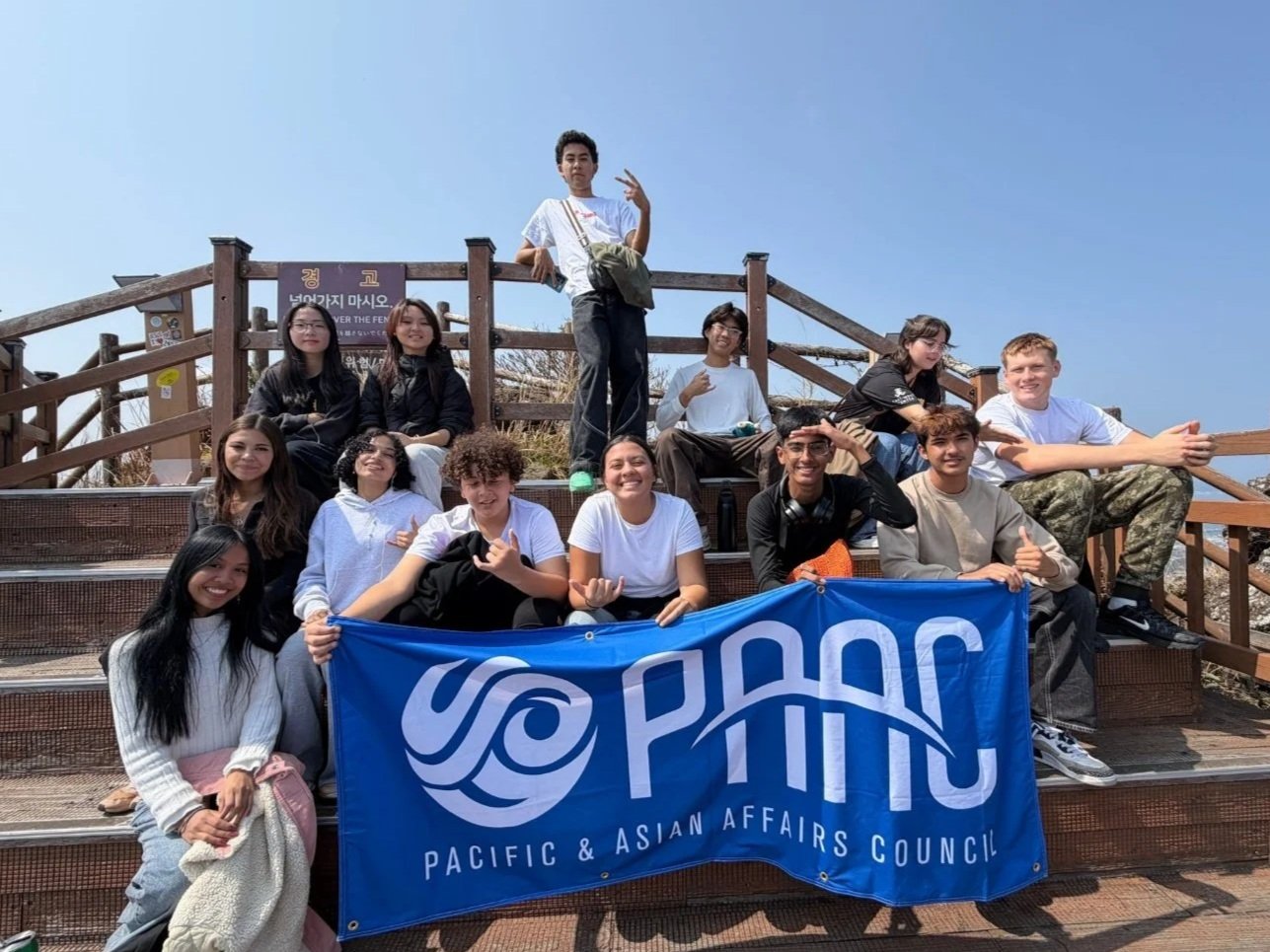
Seongsan Ilchulbong Hike Group Photo
Isabelle Myers of Pearl City High School connected the thread differently. The declining number of young haenyeo, she wrote, mirrored "the loss of youth who want to continue the tradition and culture" in Hawaiʻi — the young people no longer learning ʻōlelo, no longer practicing the ocean traditions of their kūpuna.
After the museum, the group hiked Seongsan Ilchulbong — five hundred stone steps up an ancient crater, wind cutting in from the sea. Rig Lindley-Molina wrote that the view from the top made every step worth it. Indica, who reached the summit despite what she described as "a ridiculous number of breaks," said the feeling of accomplishment was something she couldn't have recreated anywhere else.
The History That Was Never Taught
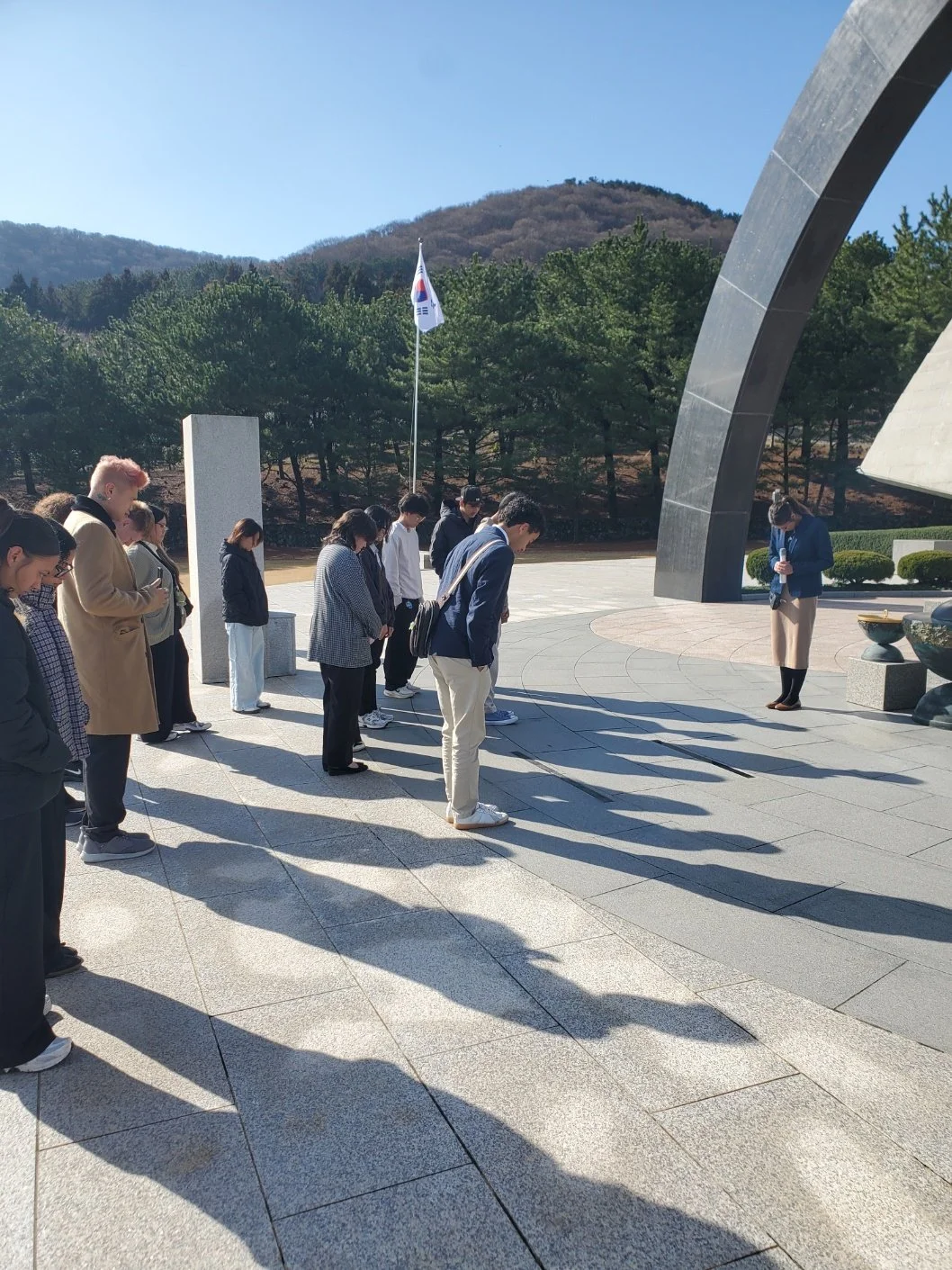
If the haenyeo days asked students to sit with cultural loss, the Jeju 4·3 Peace Park asked them to reckon with something heavier: massacre and the silence that followed.
On April 3, 1948, the Jeju people rose up against brutal martial law and anticommunist repression. The government's response was catastrophic. An estimated 30,000 people — roughly ten percent of the island's population — were killed. Survivors hid for weeks in mountain caves, surviving on water dripping from stone. The United States government played a documented role in exacerbating the crisis. For decades, the event was suppressed. It was only formally recognized nationally in 2003.
Every student in the cohort arrived at the park on March 19, not knowing what they were about to feel.
Indica Brown of Kailua High walked in and became emotional almost immediately. "The more details I learned, the more my heart sank," she wrote. "I was disgusted, especially after learning of our country's involvement in the tragedy, which could have been wholeheartedly avoided." She came out not with pity, but with a different feeling: "I left with a sense of empowerment. I stood with people who were survivors of such an event, people who built this island and continued to thrive."
Lillian Yim of Roosevelt High, who was taking AP U.S. History, drew the political line precisely: "Like how Jeju was under martial law and then the U.S. intervened to make things worse — with malicious intent to further anticommunism — Hawaiʻi has also suffered from U.S. interference. The Bayonet Constitution. The overthrow of the Hawaiian Kingdom. The U.S. held strong beliefs that Hawaiʻi was full of barbarians and used that to 'justify' stepping in."
ʻĀlohi thought about schools. "Kids in Jeju don't know that this happened and why it happened. Same in Hawaiʻi — a lot of kids outside of kaiapuni school are only being taught surface-level things about our history and culture. Why can't we teach them the truth?"
Isabelle Myers insisted on entering the cave replica exhibit — a reconstruction of the hiding places where victims took shelter, bodies represented on the ground — even as some classmates urged her away. "I would rather know and see and learn than be naive about just what exactly people are capable of," she wrote.
Sean Palamos of Leilehua High, after visiting, posted a tribute on his personal Instagram that night. In his reflection, he wrote: "I want to remember the 4·3 massacre because it taught me an important lesson to never give up. If people who were literally hunted can endure and survive, then I can face and win against any hurdles I might face in the future."
Tangerines, Tea, and the Work of Making Things
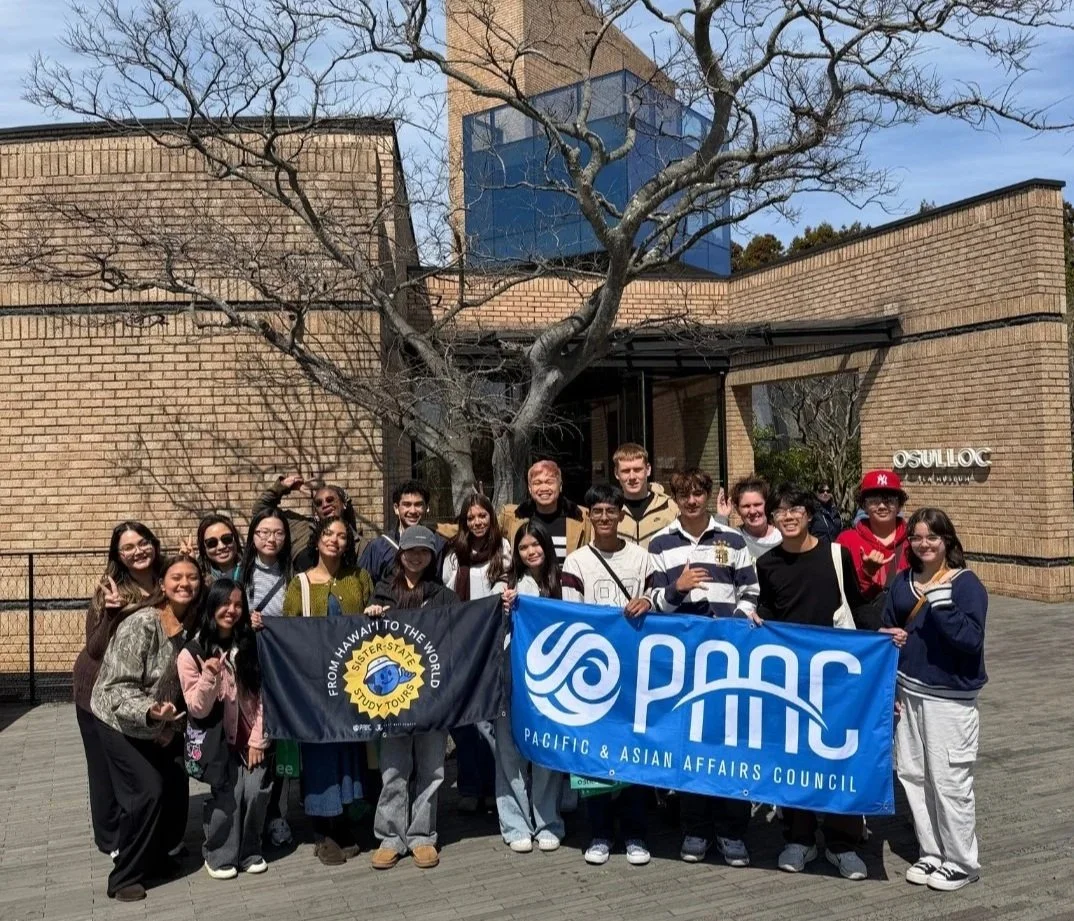
Osulloc Tea Farm and Museum Group Photo
Not every day carried that weight — and the cohort needed the lighter ones.
At the Osulloc Tea Museum, students roamed rolling green fields and sampled matcha in the café. Isabelle, who describes herself as "kind of a plant nerd," was quietly delighted to learn that tea and matcha come from the same plant — and that the plant is in the same family as her favorite flower, camellias. Indica found a shop nearby selling clothes dyed with Jeju persimmons and walked out in a teal-text t-shirt, the hangul reading something about Jeju Island that she loved even without knowing the exact translation.
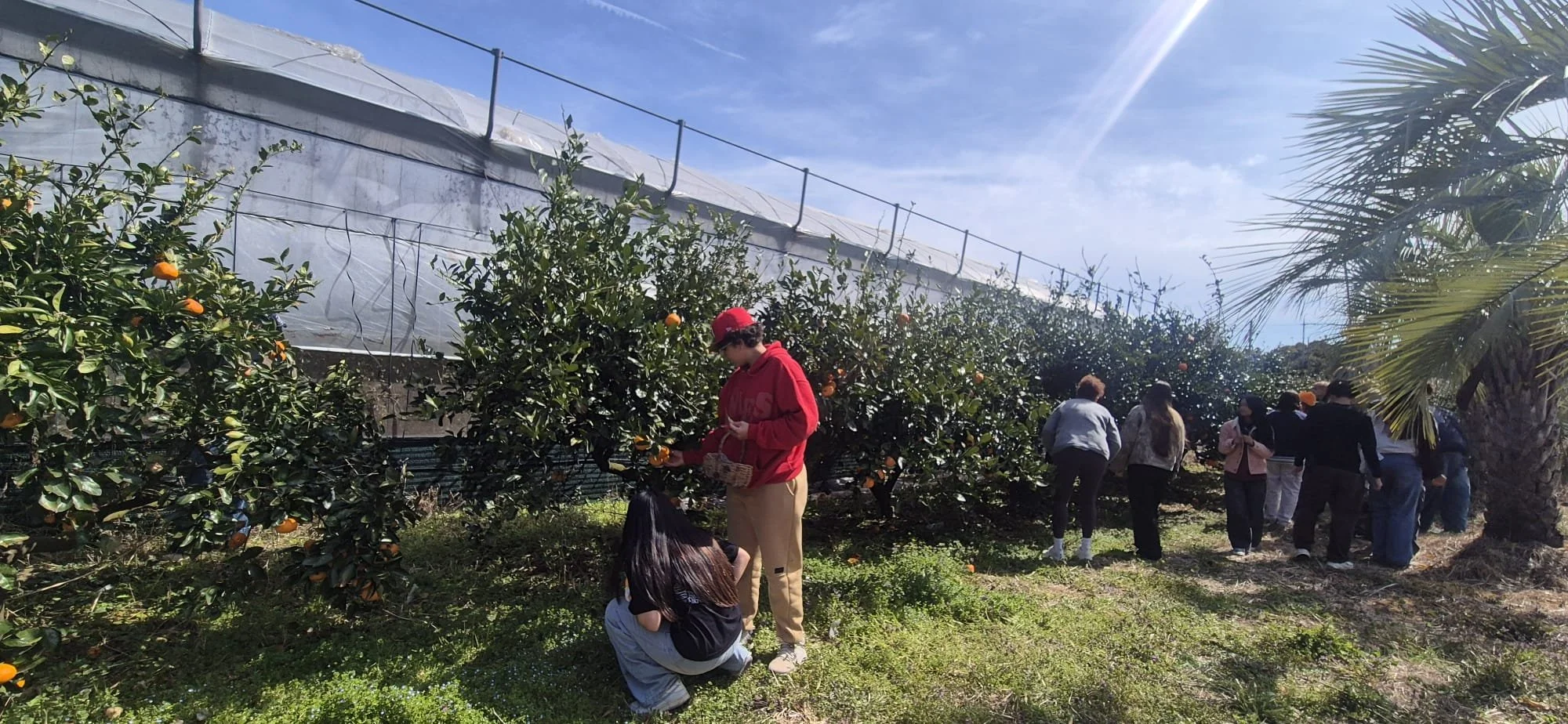
Tangerine Picking on a family farm
At a family tangerine farm, the group picked fruit directly from the trees, learned from the owner — a painter who had built the place with her husband as a merging of two life's dreams — and made jam together from scratch, decorating their boxes to carry home.
Rig Lindley-Molina, who by his own account is a picky eater and had struggled with unfamiliar foods throughout the trip, was unambiguous: "MAKING JAM WAS SO MUCH FUN."
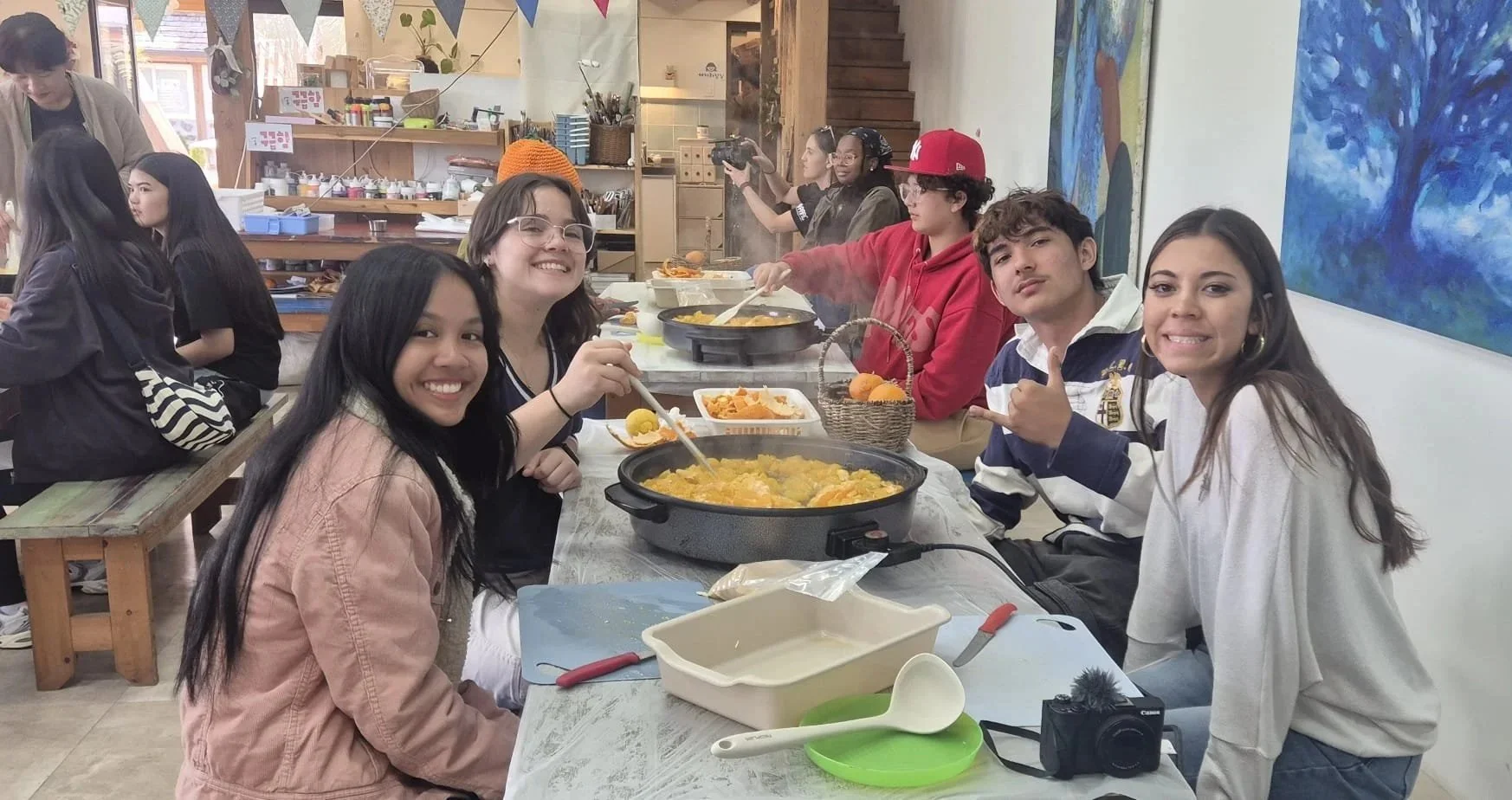
Students making tangerine jam from scratch.
Jhera Mae took something quieter from the day. The farm owner, she wrote, "encourages me to push forward in my passions no matter how long it may take." Bodhi, who had learned that tangerine farming was a government-mandated survival strategy in the 1970s — one productive tree could fund a child's university tuition — connected this to Hawaiʻi's plantation history and left with a specific thought: that islands should invest in high-value local crops that give families a reason to stay.
The Visit That Changed Everything
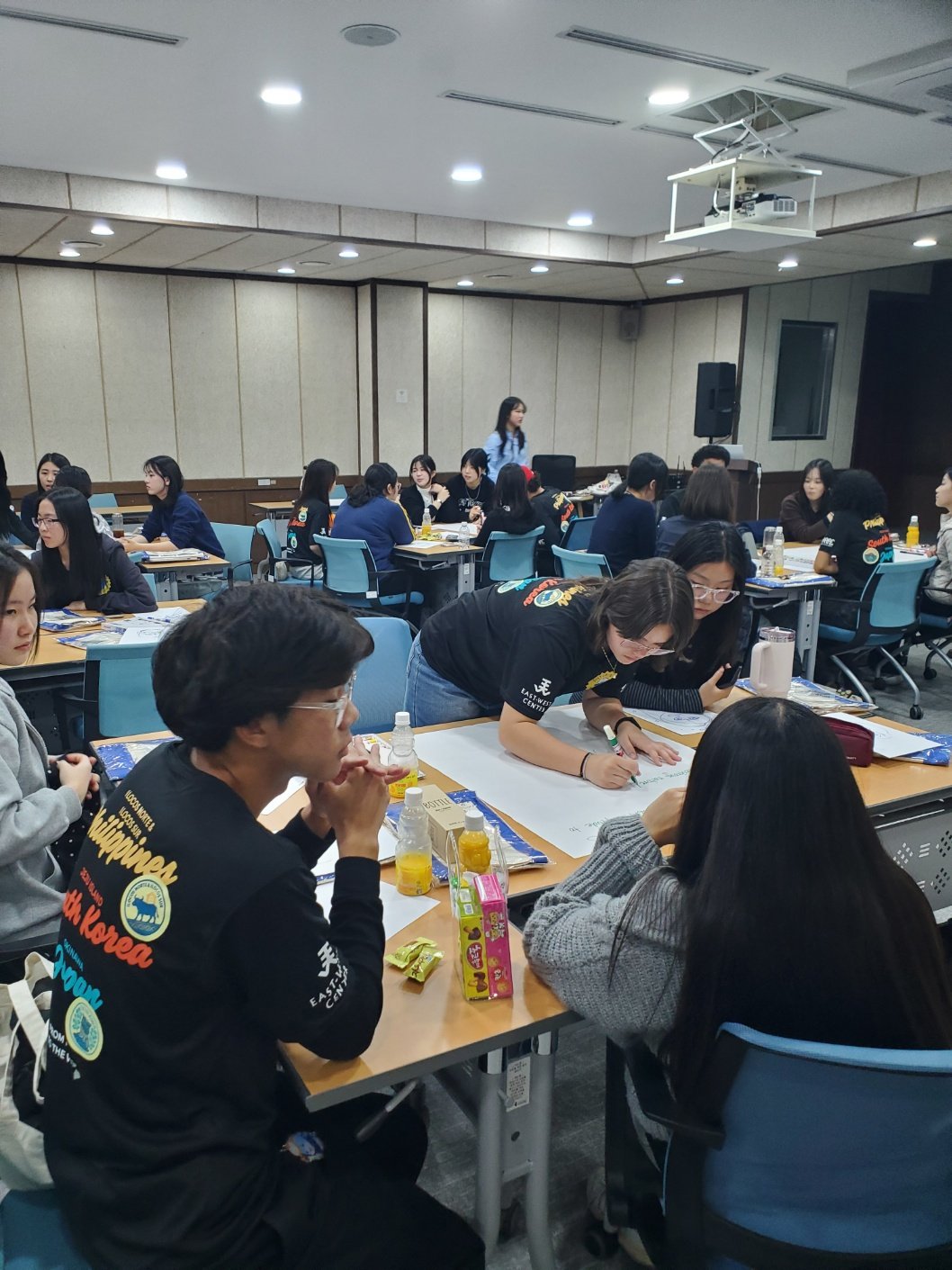
Seogwipo High School Exchange, UN Cifal Center Jeju
Ask almost any member of the Jeju cohort what they'll carry longest, and the answer is the same: the girls of Seogwipo High School.
On March 19, the delegation visited the all-girls school in Jeju's southern city — eating lunch together (school cafeteria food that Isabelle called "restaurant-tier"), touring classrooms, playing kickball and doing aerobics in PE. Several students were dressed in business casual. They played anyway.
Two days later, both groups reconvened at the United Nations Institute for Training and Research CIFAL JEJU, where they sat across from each other and did the actual work of diplomacy: comparing problems, proposing solutions, arguing about what mattered most. Tourism. Pollution. Young people leaving for Seoul, or for the continental U.S. Both groups had been thinking about these things. Both had ideas. Language was a barrier — they used translator apps and GPT chatbots and hand gestures and patience — but it was not a wall.
"The level of intellectual conversation I was able to share with them, despite the language barrier, was remarkable," Indica wrote. "I truly respected their effort and ability to speak with us. I finally found my voice on this trip."
Alliah Punzalan of Waimea High, who had been nervous about speaking in front of others, found herself at a microphone during the group discussion. "I got out of my comfort zone and presented in front of new friends and teachers," she wrote the next day. "It really means a lot to me."
Jhera Mae, addressing an imagined Hawaiʻi leader in her field notes, wrote: "One insight from today I would share is to listen more to student voice when making decisions. We are the future of this world, and the things that go on today from leaders will affect us in the years to come."
Several students have stayed in contact with the Seogwipo girls since returning home. Cassie Nakaoka of Moanalua High put it plainly: "I still keep in touch with the Seogwipo girls, showing my genuine aloha for making relationships."
What This Place Actually Is
Throughout the trip, students kept returning to a feeling: recognition. The volcanic coastlines. The overreliance on tourism. The dying language, the fading traditions, the young people leaving for somewhere larger. The history of occupation. The warmth of the people who stayed.
Lillian Yim, one of the cohort's most analytically precise voices, mapped the parallel carefully: "Hawaiʻi and Jeju share similar histories of colonization and political oppression from the mainland. Both face the same problems of being island nations — overtourism, pollution, expensive housing. One of the most obvious is sea level rise, which will result in both islands rapidly losing massive portions of land in the coming years."
ʻĀlohi connected it through creation. Jeju's goddess Seolmundae Halmang shaped the island by pulling the peak from Halla Mountain. Papahānaumoku gave birth to the Hawaiian islands. "This just shows how connected Hawaiʻi and Jeju actually are," she wrote. "Through history and shared beliefs, it makes Jeju feel like home."
In Seoul on the final days, the group visited the American Diplomacy House, where four Foreign Service Officers spoke candidly about their careers, their backgrounds, and the daily work of maintaining relationships between nations. Before the visit, Indica had been uncertain about her future — torn between environmental science and something in the humanities, unsure how to connect the two. Afterward, she wrote: "It felt like a career I connected to and could see myself really going into. No matter what I choose to study, I can still do it — because there is no prior schooling required." Sean Palamos walked out with the same shift. Noor Shehata of Hilo High had given Macnut Chocolates to nearly everyone he encountered as a gesture of aloha; he left Seoul newly curious about a career in diplomacy, carrying that same instinct into a possible professional future.
What They're Carrying Home
Levi Short of Baldwin High lost his luggage in transit. He wrote afterward that he had learned international travel comes with real challenges — and, more quietly, that he came home changed: "I am more culturally understanding, and I feel that I can make conversation with someone from any background."
Sofia Pimentel of Lānaʻi High returned with a clearer voice and a plan: to tell her classmates about PAAC, to make sure students from her small island know this door exists. "I know so much more about myself now," she wrote, "and about South Korea, and even about Hawaiʻi."
Alliah Punzalan of Waimea High, reflecting on everything, wrote: "This tour is an example of my need for self-advocacy. If I hadn't devoted so much time and effort to my application, I would not have this trip experience to move forward with me."
And Jhera Mae Paulo — who had spoken up when the room was silent, who tried new foods, who stayed curious about everyone she met, from the vice governor to their beloved tour guide Amy, wrote something that might stand as the cohort's collective statement:
"I am not sent to South Korea for vacation, but to strengthen the relationship Hawaiʻi has with our Sister State. I have what it takes to be independent if I let myself be presented with the opportunity. This trip has inspired me that I can be a leader anywhere I go, not just in Hawaiʻi."
The 2026 PAAC Sister-State Study Tour to Jeju Island did not produce diplomats overnight. What it produced was harder to measure and more durable: fourteen students who now understand, from lived experience, that the challenges facing their island are not unique to it — and that the young people on the other side of the Pacific are asking the same questions, carrying the same concerns, and willing to sit across a table and work.
The 2026 Sister-State Study Tours were made possible through the partnership of PAAC and the East-West Center, with support from the State of Hawaiʻi. The Jeju Island delegation joins concurrent cohorts in the Philippines and Okinawa, Japan as part of the largest student ambassador program in PAAC's history. To learn more and support future delegations, visit paachawaii.org.
